Category Archives: Outdoor Advertising

Creating an Irresistible Offer to Boost Conversion

marketing-consulting-irresistible-offer.jpg

So, you’ve got sufficient website traffic, a low bounce-rate and have packaged a tempting and generous offer to bring your prospective customers over the line. Brilliant! But what’s concerning is the low uptake of your core offering. Why are your customers so ambivalent about such a fantastic deal?

Sales guru Zig Ziglar once said that there are a mere 4 reasons why people won’t buy from you. These are:

– No money
– No need
– Not in a hurry
– No trust

We’ll explore some of these issues here:

An Offer Should Create a Sense of Urgency

In such a fast-paced world, increasing numbers of visitors are interested in instant reward. And by giving them what they want, you will see a correlative growth in conversion. For example, a 30% discount on a membership is a compelling offer. But making it time-limited and available to only a select few customers will attract extra interest. This is known as ‘Reactance Theory‘ – the psychology of wanting something more once the freedom to have it is perceived to be limited.

When formulating your offer, a greater sense of urgency is created when an expiry date and time is specified. So, instead of using a cliché like ‘Act Fast While Stocks Last’, you might use ‘Offer Ends Midnight 24th December’ or ‘Act Fast, 594 Sold, Only 6 Remaining’. Specify is key here. But what’s also crucial is that customers receive their incentives immediately.

If you’re giving away a free retail voucher when a customer spends more than x number of dollars, they’ll need to know they’ll receive this within an hour (or even a minute) of purchase, straight to their inbox, and will have the ability to spend it straight away.

Dull Headline? Don’t Even Bother

Business leader David Ogilvy once said: “On average, five times as many people read the headline as read the body copy. It follows that, if you don’t sell the product in your headline, you have wasted 80% of your money”.

He was right. You could have the most amazing offer in your space, putting you miles ahead of your competition, yet a dull headline will deter leads and keep conversion rates low. Your headline should be clear, empathic and relevant, never relying on clickbait by deliberately holding back information. It should also give the reader an incentive to read on.

For example, the headline ‘Shrink Your Middle: Lose 10 Lbs in 10 Days’ gives the reader a very good reason to feel intrigued and is supported by a measurable, achievable and desirable outcome. For extra headline inspiration, just look at the checkout of any major supermarket. Ordinarily, these are lined with magazines that have stand-out, attention-grabbing headlines to trigger a last-minute impulse-purchases.

The Power of Customization

Customers like to feel special, that has always been the case. And these days, technology makes it easier for any brand to offer a customized product or service. When surveyed, one in three customers stated they’re interested in trying a customized product. And large brands are already clued-in to the power of this trend. For example, food giant Whole Foods is very good at interacting with customers in a personable way via the downloadable app.

Their app gives users customized recipes and exclusive offers, as well as healthy cooking tips suited to the dietary needs and preferences of the user. By crafting your offer to speak to the individual, you’ll be guaranteed to increase your conversion rate.

Social Proofing

While customers like to feel like individuals, they also take comfort in knowing they’re not going to be your only customer. Having a tally of how many customers have purchased a product can encourage prospects to step over the line. This strategy is as old as time – just watch the shopping channels and note how presenters emphasize how many calls they’re receiving about the products they’re promoting.

This technique has always worked but needs to be crafted for your audience. Embedding a widget into your site to pull and promote real-time sales figures (e.g. “Bobby from New York bought 2 units 5 minutes ago”) or even pushing positive social media testimonials to your landing page will convince visitors that it’s safe to purchase.

Target Your Ideal Customer

Finally, your offer, no matter how tempting, isn’t going to be any good if you are attracting the wrong sort of traffic. It is therefore imperative that you conduct relevant market research and re-examine your marketing processes to ensure your customer avatar is spot on and you’re selling the right product to the right person.

To increase conversion rates, your offering must overcome the common objections that deter visitors from becoming customers. That means knowing your customer well, tailoring an offer that speaks to them as individuals, and social proofing your landing page to promote trust and persuade your prospect to part with their hard-earned cash to become a new customer.

7 SEO Strategies Still Valid in 2018

Roast-Turkey.png

The most challenging aspect of any search engine optimization strategy is staying current. The Google gods are indeed fickle masters: every year, the headquarters in California roll out more than 500 changes to their search algorithm (Moz).

To help you stay current with the latest search engine trends, I’ve aggregated and analyzed seven SEO strategies that remain valid in 2018. We’ll discuss each strategy in-depth, and teach you how to implement it most effectively.

1. Long-tail Focus

Long-tail keywords started becoming an increasingly important part of search engine strategy in years past, and today they’re still as relevant as ever.

If you’re unfamiliar with the term, here’s a quick refresher: long-tail keywords are search queries that are much more specific than the typical query most people Google.

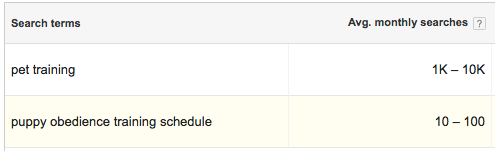
For instance, “pet training” is a short, general, high-traffic search query. However, the long-tail keyword “st bernard handshake training” is longer, much more specific, and low-traffic.

pasted%20image%200.png

Because the second (long-tail) keyword has a much lower search volume, it’s also far less competitive. Thus, it’s a much easier keyword to rank for. Additionally, since it attracts a very specific kind of audience (pet owners trying to develop a training schedule for their puppies), the traffic the keyword attracts could also be more targeted toward your product/service and consequently higher-converting.

2. Voice Search Optimization

Since 2008, voice searches on Google have increased by a factor of 35x (Search Engine Watch). And that trend is forecasted to only continue–in fact, comSore estimates that by 2020, half of all queries will be voice searches.

To properly optimize for voice search, consider the context in which most voice searches will happen. For instance, many voice searches occur on mobile. Imagine a scenario where a user is driving and needs to find the closest pet store to him/her. The natural thing to do would be to pick up the phone and voice search “pet stores near me.”

Pet-Store.png

If you run a brick-and-mortar business, this trend tells you that location SEO and ensuring that all of your snippet details are correct (as in the image above) will become increasingly important.

But even if you don’t have a physical location, voice search optimization still carries implications for your overall SEO strategy. Remember that when people voice search, they use phrases closer to conversational language: that means the use of extra prepositions and filler words, resulting in generally longer search phrases.

This goes back to the emphasis on long-tail keywords, reinforcing the importance of long-tail to your SEO strategy.

3. Lock-Down Security

Back in 2014, Google’s Webmaster blog announced that that the use of HTTPS to secure a website had officially become a ranking signal and an element in the search algorithm. In other words, secure sites rank better.

Since then, the number of webmasters adopting the HTTPS protocol has skyrocketed. Search Engine Land estimates that nearly two-thirds of domains ranking in the top three positions of search results now use HTTPS.

The use of the HTTPS protocol has benefits outside of SEO, too. Besides the obvious addition layer of security, HTTPS is a recognizable signal of security to your website traffic. Knowing that your site is well locked down, your traffic will be more likely to convert and purchase your product/service.

4. Blazing Page Load Speeds

Page load speed remains an essential ranking signal in 2018, since it was officially announced as one nearly eight years ago in 2010.

The importance of load speed within Google’s search algorithm was reinforced this past year as well, when Google revealed that it aims to include page speed in the mobile first index.

If you haven’t heard of it, the mobile first index is essentially Google’s search rankings based on the mobile versions of the websites, rather than on the desktop version. At current, Google uses the load speed of desktop versions of websites as a ranking signal, as it hasn’t yet incorporated speed testing of the mobile version into its algorithm.

marc-olivier-jodoin-291607.jpg

SEMLand reports that Google plans to integrate load speed of mobile versions into its mobile first index algorithm soon. To ensure that your website maintains high rankings on mobile searches, you need to certify that both the desktop and mobile versions load lightning fast.

You can use a tool like Dareboost or Google’s Page Speed Tool to test load times of both mobile and desktop versions of your website.

5. Google Answer Boxes

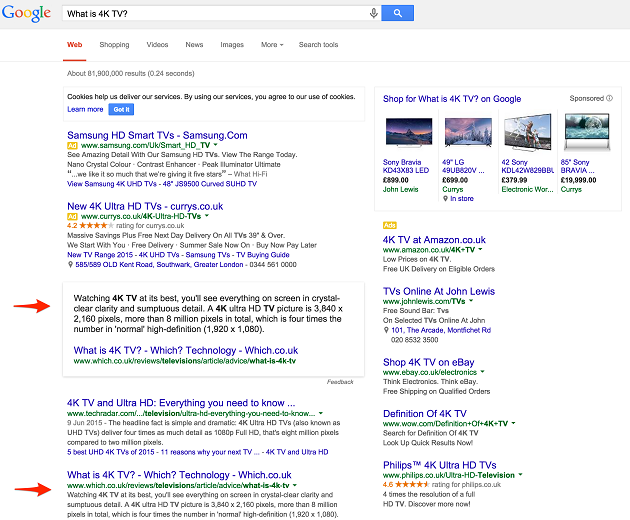
Google Answer Boxes are a type of featured snippet that appear beneath the search bar and above the standard listings for certain queries. See an example below:

Roast-Turkey.png

Answer boxes are a relatively recent addition to Google’s search capabilities, so optimizing your website to achieve this coveted location is still an evolving process.
Contrary to what might seem to be the obvious path, Google doesn’t simply pull content for the answer box from the first result in the SERPs. In fact, it pulls content from any one of the listings on the first page–so you just need to get to the first page for a shot at getting into answer box territory.

Format is crucial here: having a numbered or bullet-point list (like in the example above) or table can be the one element the algorithm looks for to catapult you into the answer box. Another essential component is a logical answer to the query within the text of the page.

4ktv.png

Image credit: Search Engine Watch

For instance, in the example above, the answer box identifies a result that contains a straightforward, accurate answer to the search query. When trying to rank for queries in a similar style, you’ll need to have at least one instance of such an answer on the page.

6. Quality over Quantity

The familiar adage of quality over quantity is never truer than in the digital marketing arena. The Internet is already bursting with content–the big four of content storage service (Google, Amazon, Microsoft, and Facebook) alone contain 1,200 petabytes of data, or 1,200 billion gigabytes. And that’s just those four providers.

Clearly, creating content simply for the sake of owning content is useless when there’s already such a massive ocean of data for your work to get lost in. Instead, take more time to create less content of a higher calibre–the kind of content that users will actually find helpful and want to consume.

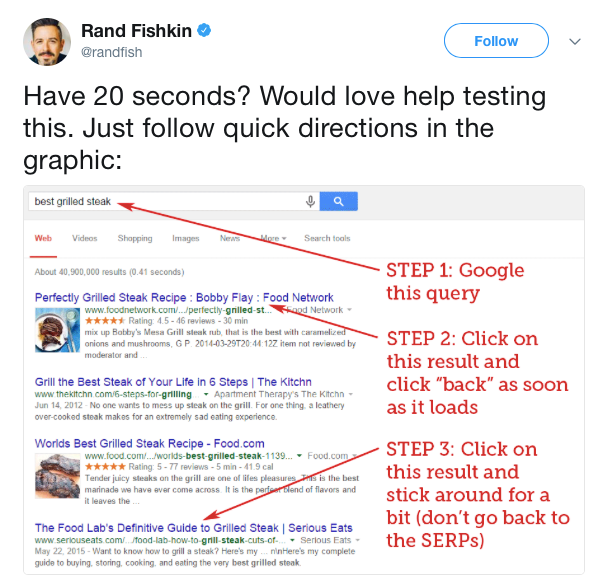
Rand Fishkin (formerly) of Moz ran an unusual experiment confirming the necessity of quality content to solid SEO. He tweeted out the below instructions to his huge following (which numbers in the hundreds of thousands).

Fishkin1.png

In just over an hour, Google sensed the increased user engagement on the third link, and moved it up the first spot.

Fishkin2.png

Google uses such analytics as bounce rate and time on-site to assess the quality of a piece of content. The higher the quality of your content and more engaged your users are, the better you’ll rank.

7. Mobile Optimization

You’ve been hearing this for years, and in 2018 you’ll only hear it again. Mobile is king.
In 2016, almost 60% of all search queries were done on mobile (Search Engine Land). And in 2017, the continued rise of mobile was confirmed when comScore discovered that 69% of digital media consumption is on smaller devices.

Simply put, mobile search isn’t going anywhere. On the contrary, it’s taking over from desktop in many industries, especially ones that rely on location-based search.

Make sure your website is mobile-optimized and as engaging and easy to navigate on smaller devices as it is on a desktop. Configure AMP on your website, and ensure that the mobile version of your content loads lightning fast.

Wrapping Up

With all the difficulty of keeping up with Google’s stringent ranking standards, as well as the continued emergence of new ways people find information online (such as mobile apps and social traffic), some have conjectured that SEO is dead.

But it’s not. Google still gets over 5.5 billion searches per day. And three of the top four websites in the world in terms of traffic–Google, YouTube, Facebook and the Chinese website Baidu–are some kind of search engine (HostingFacts).

Thus, even in 2018, SEO is still very much worth the time and effort required to learn and apply the constantly-evolving optimization techniques. With this guide, you should be well set to make this year the best year you’ve ever had in terms of organic search traffic.

This guest article was written by Ryan Gould, VP of Strategy and Marketing Services at Elevation Marketing.