Category Archives: Uncategorized

How To Create A Perfect Personal Freelance Brand

Nancy%20Howard%20.jpg

Freelancer’s personal brand … This idea raises more questions than answers. And in fact, even if you are not doing anything but working with your customers in standard mode, your brand is already being formed and is developing. However, you can always make the decision to improve the perception of you by your potential clients and invest a little time, effort, and sometimes even money in developing your brand as a freelancer. In this article, we will give you some basic tips.

Use Your Name and Work on Your Bio

Since this is your personal brand, it is always better to use your name or its variations. Moreover, you also need to create your bio, which you can reuse at different sites and for different purposes. For example, you can write your full biography on your website, publish a shorter version on Linkedin, come up with three main lines for Instagram, and fit it into 140 characters on Twitter. If you have any problems with creating content, you can find help at Best Writers Online custom writing reviews.

Think About Your Colors and Logo

From the point of view of marketing psychology, each color has its own emotional message. In order to find your colors, you need to understand what values ​​you want to convey to your customers. And what’s more, your values ​​must exactly match the values ​​of their business. For example, if you help a business grow with SEO promotion, then your colors are the colors of development – yellow and green.

In addition to colors, you also need to think about your logo. And here, most likely, it makes sense to turn to professional designers, of course, if you yourself do not create logos for your customers. Your logo is one more face of your personal brand, and it is better when it is compelling and recognizable.

Build a Strong Social Media Presence

It has already become common practice to analyze the profile of companies or individuals in social networks before deciding to start cooperation. Therefore, you need a strong and correct media presence that will reflect your personality and show your professionalism in equal proportions.

Balance is the keyword in this case. And this applies not only to Linkedin where it is necessary to adhere to the framework of your professional activity but also to all other social platforms as well – you can never know who is watching your profile while you are sleeping.

Make Your Personal Brand Understandable

Freelance means the complete absence of geographic boundaries, and therefore, most likely, you will work with clients from different countries, cultures, and mentalities. This is ideal if your brand does not initially imply multiple interpretations and is perceived by all equally right.

However, sometimes it makes sense to adapt it a little to the needs of your new customers. And this is one more case when you should turn to specialists – for example, to Online Writers Rating writing service reviews, of course, provided that you yourself do not work in this direction.

Get Used to Overdelivering

Your reputation builds your personal brand better than all the other tips that can only be given in this case. Reputation – and word of mouth as a result. Even if you build the right personal brand from the point of view of marketing, it will not make sense without the reputation of a professional and a person who can be trusted – because in most cases, freelance cooperation is based on oral agreements and mutual understanding.

Therefore, before building your own freelance brand, make sure that you know how to get your work done before the deadlines, and moreover, get used to doing a little more than you are asked. This will be the best investment in your reputation, and brand, respectively.

Always Ask for Feedback

It is much easier to adapt a personal brand than a corporate one. Therefore, it always makes sense to ask for feedback from your customers, as well as keep track of what other users are saying about you online. These insights can be good tips for further development as a person and as a professional, which will build your reputation and brand in the future.
How Artificial Intelligence is Changing the Graphic Design Industry

app_screen_purple.jpg

The technology world is on the verge of another revolution, as AI and Machine learning has transformed the graphic design industry entirely.

Today, AI is dominating several industries and it’s often linked to the future of technology.
It has been displayed as a way to reconstruct the world to make it a better place to live for humans.

Presently, graphic design has become an integrated part of every industry. However, advancements in technology, the graphic design industry relies more on computers, and artificial intelligence applications.

Whether to create a logo or website design, businesses are now replacing graphic designers with AI applications. While the technology and software firms embrace AIs with open arms, traditional sectors are a bit slow to adopt it.

Artificial intelligence holds great potential for the graphic design industry. However, to make it happen, the myths and hype about it need to be deciphered.

In this post, we are going to see how Artificial Intelligence is changing the graphic design industry.

AI – a friend or foe of the Design Industry?

AI has become a controversial topic for debaters. Presently, there exist two opposite viewpoints about AI.

Researchers and scientists are working continually on the technology effort to discover its impact in the future. Industries such as engineering, sports, entertainment, and graphic design are highly influenced by AI technology development.

With a huge impact on these sectors, AI has started ruling our lives.

However, this is not a horrifying fact for people. What frightens them, particularly graphic designers, is that AI is shaping sectors that were originally considered to be complicated for machine intelligence.

AI has proved that it’s not only executing tasks faster and in a better way but also thinks creatively like a human. AI is becoming a dominant impact on the design industry. And futurists think that soon AI technology will be able to think logically and critically to perform extremely productive and complicated tasks in the near future.

So will this technology surpass human intelligence? Let’s examine the concept in detail.

AI is Not New in the Design Industry.

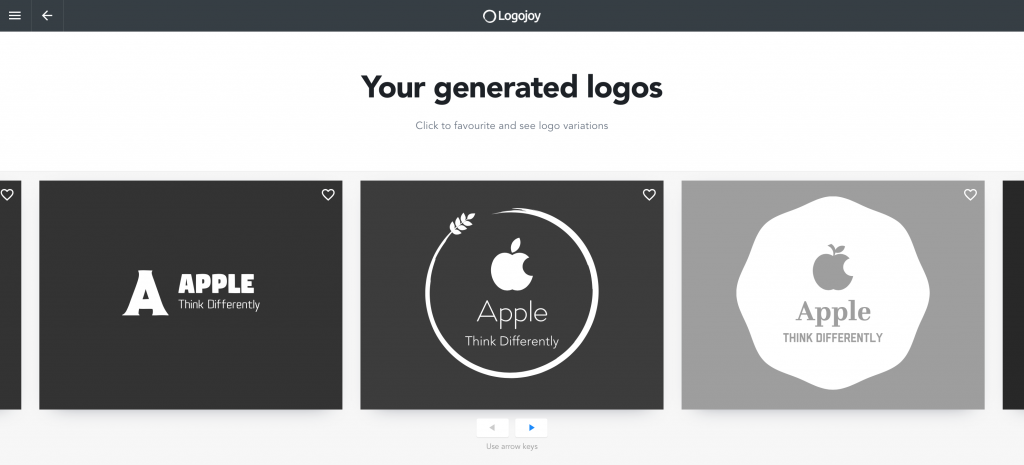
The simple AI applications have been existing in the market for quite some time. Several websites are providing unique logos by just clicking a button. And people are using it to create a logo for business effortlessly.

These websites offer cheap and quick online logo design services to attract users. They utilize AI software to produce countless logo options based on the visual criteria described by the user.

However, software can’t replace the job of a designer. It can’t provide you the solutions at a human level. The tool can offer you several logos with the variation of Font, style, colors, and symbols regardless of your choice and preferences.

For example, here is the actual logo of Apple

think_different.jpg

And here are the logos generated using AI

apple_versions.png

Whereas If you are not happy with the logo created by a designer, you can contact the designer to tweak the design.

Similarly, there are apps like Prisma that can transform an image into an artwork.

These apps are popular in the consumer market, but they haven’t left any mark in the custom branding industry. Design is not just about the look, it’s also a crucial part of how customers perceive your brand.

Cloud Computing & Graphic Design

Cloud computing has many advantages for businesses across industries, including graphic design. Previously, the graphic designers were bound by the restricted power of the processor that runs their local machine.

Today, anyone can utilize the limitless power of cloud computing networks. It speeds up the resource-intense processes and allows a person to create 3D modeling, world-design, and particle rendering.

AI-Powered Design – The Positive Sides

AI is not an enemy of graphic designers. There is a common misconception when discussing the impacts of Artificial Intelligence that people consider it to be a replacement for human jobs.

In reality, according to a report, AI produces just as many job roles as it replaces. AI doesn’t replace graphic designers. If controlled accurately, it enhances a graphic designer’s efficiency, speeds up the art process, resulting in high-quality work.

For example, the combined use of AI and machine learning during 3D modeling allows designers to perform and run thousands of design simulations within an hour. And this helps in reducing the time spent on R&D and allows designers to deliver better work in minimum time.

This proves that AI simply enhances the efficiency of designers.

Impact on the Demand For Designers?

Usually, AI is used to improve the overall design process. However, there are some recent incidents of AI replacing the job of designers completely.

There is a huge impact of AI on the design industry. Website themes are considered as the death of web designers’ job roles. Similarly, the design templates are killing the job roles of graphic designers. The industry is developing differently.

But, designers will adapt to this change. A century ago, pen, paper, and colors used to be the identity of a designer. Now, we have designing tools like illustrator & photoshop. And in the future, we will have AI.

The tools and styles may change, the role of designers will remain inevitable.

Future of Graphic Design

The designing tools have evolved continuously over the years. So, certainly, it’s not appropriate to compare the downfall of designers with emerging design tools.

Rather, we should compare it with the projects needed by the clients. A century ago, designers were requested to create simple hand-painted designs and typing based projects. Today, they require creatives for digital print, web designs, and designs for mobile devices.

So, the growing demands of clients and developing modes of information are shaping the tools and technologies we require; not to limit the job roles of a designer, but to improve it.

With virtual reality becoming very common, in the future, designers will require AI-powered tools, instead of being sacked by them.