
Why Marketers Need Stock Music (And Where to Find It)

slack_video.jpg

Everyone knows video has taken center stage in digital marketing.

And as more marketers start producing videos, the question becomes less “How do we do this?” or more “How do we do this well enough to stand out?”

Making something memorable — whether it’s a video, a tagline, or a billboard — is marketing’s oldest and most critical mission.

So how do you make a memorable video? The camerawork, lightning, script, and acting are all important.

But there’s one thing new video makers often overlook: the background music. And that’s a shame, because music plays a significant role in how people react to any type of visual content.

In this article, I’ll explain why quality music is so important for your videos and where you can find affordable stock music for your work.

Why Background Music Matters

Humans are musical creatures — we’ve actually been making music for thousands upon thousands of years.

When we hear music specific parts of our brain react and our mood changes. This phenomenon is so strong we often use music to regulate our emotions. When you’re feeling low, you put on something joyful. When you need to focus or relax, you put on something calming.

All around the world, this happens like clockwork.

Anyone who aspires to succeed with video marketing should take note. Music directs people how to feel, and it heightens our emotional reaction to media of all kinds.

The power of music is immediately apparent in ads that go straight for the heartstrings, like Budweiser’s 2014 puppy commercial or Coca Cola’s “Wonder of Us” spot.

But background music plays just as important a role in less dramatic marketing.

Slack’s 2018 spot is almost completely devoid of dialogue. Instead, the video relies on sound effects and background music to drive the story forward.

Notice how calm the music is in the beginning. We find Geoff the lion in a moment of reflection. As soon as inspiration strikes, he messages the team. Then the music springs to life.

The tempo picks up, the song expands to include new instruments, and the audience understands innovation is underway.

The entire commercial hinges on this song, and yet the music itself isn’t that spectacular. It’s working in the background to create a mood that enriches the visuals.

Quality background music can be found in almost every successful marketing video — not just big production ad spots.

Take Acorns’s animated explainer video. These videos are a dime a dozen, but Acorns succeeds by scoring the animations with a track that builds as the explanation moves along.

Even though Acorns itself is a very interesting idea, this video isn’t dynamic by nature. No explainer videos are. So the background music adds some energy to what would otherwise by a pretty dry piece of content.

Finally, let’s look at a talking head video from Drift.

Like animated explainers, these videos are very en vogue on company YouTube channels.

The problem is, watching a person stand in front of a camera and talk to you is pretty awkward. It becomes even more awkward when they aren’t trained actors.

Like in the previous scenarios, background music helps a lot. It papers over the uneasy pauses or not-quite-right inflections that happen when you shoot with actors who aren’t seasoned veteran.

So whether you’re filming a full-fledged commercial or simply producing some educational content, you’re going to need stock music for your video strategy to excel.

How to Find Quality, Affordable Stock Music

Licensing music used to be unbelievably complicated.

To get permission to use one song, you had to negotiate with all of the right holders, which was typically a smorgasbord of label exces, songwriters, artists, and publishers.

Suffice it to say, the process is complicated and expensive.

That left marketers with little recourse.

You could’ve hired musicians to record original music, but that’s still expensive — and time consuming.

You could have scoured the internet for free music, but we all know those results are going to sound like bad remixes of Keyboard Cat.

Thankfully, a combination of entrepreneurial spirit and technology has made the entire endeavour much simpler.

These days, you can pick from a number of stock music providers. These companies have essentially transformed music licensing into Netflix.

All you need to do to access troves of royalty free music is sign up for a subscription and pay a monthly fee.

The songs are dubbed “royalty-free” because you don’t have to pay fees to the rights holders every time your video racks up more views. Your membership fee takes care of that.

In most cases, you’ll be able to license an unlimited number of quality songs from the audio library, and you’ll retain permission to use those songs forever. (That’s important to protect yourself from copyright infringement.)

So whether you’re making a commercial, an explainer video, a podcast, or even a slideshow, you’ve never had more choice for quality stock music.

And that matters, because the better your music, the more powerful your message.
Brands That Hire Influencers For Inauthentic Insta-Tourism Do Disservice to Customers

insta_tourism.jpg

Today’s hyper fluidity of travel, connectivity and social media sharing make living the millennial dream of international and exotic travel experiences an easy reality. Unfortunately, a deeply troubling facet has emerged from that world that I can no longer be silent about – called Insta-tourism. And yes, I can legitimately complain about this, because I myself am a millennial.

Let me explain. Recently, a friend and I embarked on a trip to Southeast Asia, and in planning the trip, we did what most millennials these days do – we built our itinerary by hunting for the most popular geotags and added them to our extensively-tabbed and color-coded Google Doc. Full disclosure: the Google Doc had nothing to do with being millennials; it was because of my extremely detailed personality.

With our AirBnB’s booked, my new shiny Away luggage packed, we were ready to depart for Singapore and Bali. As quintessential millennials, we preplanned Bali and Singapore clothes, figured out our Sim card situation to stay connected, and purchased travel necessities from the latest in direct-to-consumer brands.

But then, Day One of vacation, sitting drinks-in-hand poolside and beachside at the popular beach club Potato Head, it began. I noticed hordes of people snapping shots in the same pose for more than an hour until the perfect photo was captured. It became immediately clear that these types of destinations actually tailor their environment and atmosphere to appeal to social sharing. I began asking myself “Why do people do this? What is the appeal?” I quickly found myself not wanting to be that person.

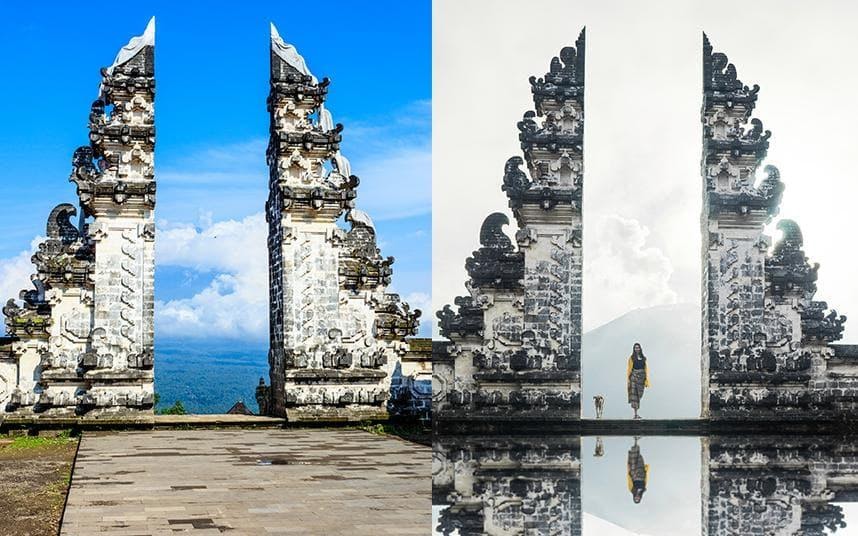
A few days later, we visited Lempuyang Temple – also known as the Gates of Heaven, which certainly lives up to its name. However, what you don’t see from all of your friend’s social posts is two things – the less glamorous side of a 230am wake up call to get there, and more jarring, our realization that most of the amazing Instagram photos and posts at the temple are actually faked using a mirror held beneath the glass to mimic the appearance of water beneath the stone. The method is even chronicled in an article in The Telegraph.

From that point on, we simply couldn’t take it anymore. Since we arrived in Bali, it became abundantly clear on numerous occasions that popular geotags were simply popular because it was easy to stage a very “Instagrammable” photo there. This wasn’t the experience we were interested in. From that moment forward, we decided to instead focus on meaningful connections with the locals we came into contact with.

Returning from Lempuyang Temple, we found some redemption with our driver, who explained how much the island has changed in recent years, specifically because of Instagram. He was kind enough to pull over into some less traveled scenic bluffs and regaled us with stories of the people in the area. We were much more interested in this. The island is so much more meaningful than a handful of geotags and staged photos.

The next day, on a snorkeling trip to Nusa Pineda, we found further redemption with our afternoon driver. He told us stories about how he and his wife lived on the island and what their life was like. We appreciated how much he was willing to share with us and how much effort he put into ensuring that we were getting to see the island’s true beauty. The conversation made a lasting impression on me.

As we departed the island, we wanted to show our appreciation for the experience, so we offered him a tip that reflected our appreciation. He was shocked and expressed that it was a lot and he could not accept it. We insisted and told him that the day he provided us meant more than he could ever know. He then shared with us, “this will change my family’s life this month.” It was at the moment I knew that we were so focused on hitting the vacation “hotspots” that we had forgotten the most important aspect to vacation experiences – authenticity.

I work with brands every day, many of which retain a very authentic approach. My vacation reminded me more than I ever could have imagined about the importance of this. Recently I came across several beauty brands that hosted an influencer retreat in which they flew several personalities to a tropical island for a once-in-a-lifetime experience. I found myself asking ‘what’s in it for the consumer?’ Sure, the influencer gets a free vacation and the brand gets some glitzy content. The consumer, on the other hand, gets left with an inauthentic, cold experience, devoid of any meaningful connections.

I have two pieces of advice – one for brands and one for travelers. For brands, don’t ever forget the value of telling and capturing a story. A story is more powerful than you’ll ever know. It unites people as an audience, forges an emotional connection (which drives loyalty) and creates lasting sentiment. For travelers, it’s very simple, do yourself a favor, don’t fall into the trap of Insta-tourism. Disconnect and experience the local culture. The stories that you bring back may even change you. No one will miss that inauthentic “candid” photo that you and 1,000 other people posted to Instagram.

This guest post was written by By Donald Hair, Group Account Director, North America, The Social Element